

Cycling the ViaRhôna from Lake Geneva to Lyon, France
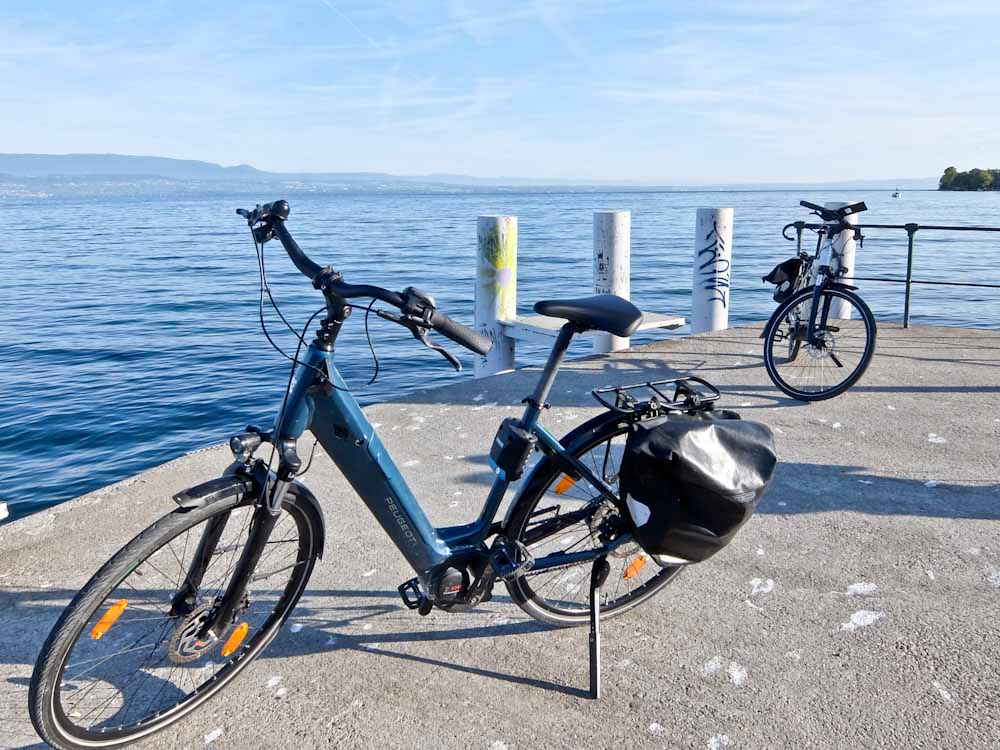
The Rhône begins its long journey to the Mediterranean in the Alps, emerging from the mountains before flowing through vineyards, orchards and some of France’s most attractive towns. The ViaRhôna follows its course for more than 800 kilometres, starting at Lake Geneva and ending at the Mediterranean.


I’m going to be doing parts of the northern section from Thonon-les-Bains on the shores of Lake Geneva to the city of Lyon. It’s a journey that combines Alpine scenery, riverside paths, vineyards, historic towns and some seriously good food.


One of the pleasures of the ViaRhôna is that it doesn’t demand constant attention to navigation. The route is well signposted, and the river provides an obvious geographical thread. Most of the time I can settle into the rhythm of pedalling and just enjoy watching the landscape unfold.


Day 1 Thonon-les-Bains to Lake Geneva


Thonon is a fitting place to begin. Sitting above the southern shore of Lake Geneva, this spa town has a distinctly Alpine feel, with the mountains rising behind and the lake stretching towards Switzerland. The Rhône is hidden, running underneath the middle of the lake, but for the next few days it’s going to be my constant companion.


The opening stages take me through the countryside of Haute-Savoie. It’s a mixture of dedicated cycle paths, quiet roads and stretches shared with other traffic. The reward is the scenery: wooded hills, meadows, villages with shuttered houses and, whenever the trees part, glimpses of the Alps.


I stop at the stunning medieval village of Yvoire, and take a tour of the Chateau’s beautiful gardens of the five senses. The next village is the equally charming Nernier, a good place for lunch. Other short detours lead me to tiny ports and sandy beaches. Finally the trail follows the road into the busy city of Geneva, its iconic fountain always visible.


Day 2 Chanaz to Saint-Genix-les-Villages


I skip a number of stages and transfer to Chanaz, a small canal side village, sometimes described as the Little Venice of Savoy. Small cottages cluster by the water and boats move slowly along the canal. It’s a pretty place.


Now, in early autumn, all is quiet and there’s plenty of time to visit local artisans. A honey producer has her hive on a barge and offers tastings. A coffee roaster attracts by the aroma and, higher up, there’s a water mill, still producing flour and olive oil in the traditional way.


A boat trip takes me out on the canal to join the huge Lac du Bourget, the largest natural glacial lake in France, a short excursion before I get back on my bike. The trail meanders through the beautiful Bugey region, still following the Rhône below the imposing Grand Colombier Mountain


In Belley, I pause to visit the distillery of Sainte Famille, famous for their monastic herbal liqueurs but now also producing zero alcohol drinks. This is an area where food matters as much as scenery. Bugey is known for its wines, while the surrounding countryside produces cheeses and other regional specialities.


My destination is Saint-Genix-les-Villages, famous for its distinctive Brioche, filled and topped with vibrant pink sugar coated almonds. The town sits at confluence of the Guiers and Rhône rivers, and I’m lucky enough to spend the night in the Chateau.
Day 3 Saint-Genix-les-Villages to Lyon
With its position on the border between France and the Duchy of Savoy, in the 18th century Saint-Genix became a prime hub for smugglers. The most famous of these, known as the Robin Hood of France, was Louis Mandrin and a small museum tells his story using multimedia.


I continue through unspoilt countryside beside the Rhône. Hidden in the magnificent landscapes of the southern Bugey, with their mountains and forests, lie splendid lakes and marshes. I pass lovely villages like Saint-Sorlin-en-Bugey, a medieval village with castle and lunch is by the Glandieu waterfall.


Another 18 kms, brings me to Morestel, a handsome medieval town known for its stone houses, narrow streets and artists. The most famous of these was François-Auguste Ravier, the leader of the 19th-century Lyon school of landscape painting. The house where he spent the last years of his life is now a galley dedicated to his work.


I now take a transfer to Lyon, my final destination. At the confluence of the Rhône and Saône, the city has always been shaped by its rivers. It is also one of France’s great gastronomic centres, making it an ideal place to finish a cycling journey. But, before I finish, I get back on my bike and explore the old city, with its Renaissance buildings, narrow passages and bouchons. A plate of local specialities and a glass of Rhône wine feel like an entirely appropriate reward.


What I like most about the ViaRhôna from Thonon to Lyon is the variety. It begins beside one of Europe’s great Alpine lakes, passes through mountains and vineyards, follows the Rhône through historic towns and finishes in a major French city. The cycling itself is only part of the experience. There is wine to taste, cheese to discover, Roman history to investigate and countless cafés in which to recover.
Factfile
GO: Swiss flies from London Heathrow to Geneva and Lyon.
INFO: ViaRhona has information about the route.
Prolynx Sports can supply e-bikes.
STAY: Résidence les Baladines is right in the centre of Thonon-les-Bains.
The Shana Hotel, on the shore of Lac du Bourget outside Chanaz, is comfortable and quiet.
Chateau de Saint Genix sits above the town and has good food.
Campanile Lyon Part Dieu is a modern hotel close to the Lyon’s main station.
EAT: Brasserie du Général in Thonon is good for lunch.